25 Cat SVG DXF, EPS, JPG: What You Actually Need to Know Before Downloading
If you're searching for cat-themed design files—whether to cut with a Cricut or Silhouette, layer into a Canva presentation, prep for print-on-demand, or import into Adobe Illustrator—you’ve likely seen listings like 25 Cat SVG DXF, EPS, JPG. It sounds straightforward: 25 cat designs, multiple formats, instant download. But not all bundles deliver what creators truly need—and misunderstanding the details can cost time, money, and creative momentum.
What This Bundle Really Is (and Isn’t)
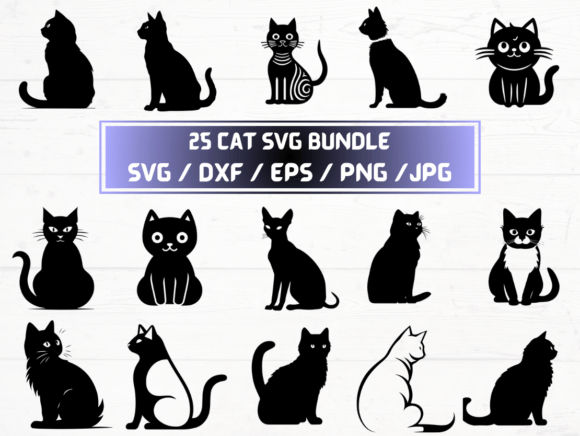
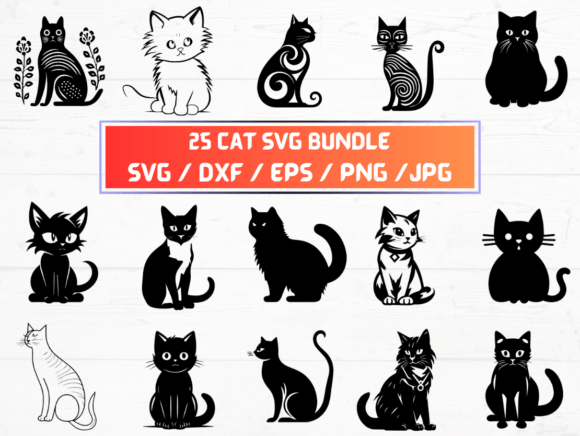
This listing delivers 25 Cat SVG DXF, EPS, JPG—plus PNGs at 300 dpi with transparent backgrounds—all compressed into a single ZIP folder. It’s a digital-only product: no physical item ships, no tracking number arrives. You get clean, ready-to-use files in five widely supported formats, each serving a distinct purpose:
- SVG: Ideal for web use and cutting machines that support vector paths (e.g., Cricut Design Space, Silhouette Studio).
- DXF: A legacy vector format still required by older CNC software and some laser cutters—especially useful if you’re working with industrial-grade equipment.
- EPS: A reliable, editable vector format compatible with professional design tools like Adobe Illustrator and CorelDRAW.
- JPG: Raster images best suited for quick previews, social media posts, or basic print layouts where transparency isn’t needed.
- PNG: High-resolution (300 dpi), transparent-background raster files—great for overlays, mockups, or platforms that don’t accept vectors.
The value lies in flexibility—not just quantity. Having all five formats means you won’t hit a wall mid-project because your machine or software only accepts one type.
A Common Misstep: Assuming “All Formats Are Equal”
Many buyers assume that if a file is labeled “SVG,” it will behave predictably across platforms. That’s not always true. Some sellers export SVGs from raster sources or use non-standard coding—resulting in missing layers, broken paths, or inconsistent scaling. The same goes for DXF: poorly structured files may import as ungrouped lines instead of closed shapes, making them unusable for precise cutting.
Example: A small business owner orders 25 Cat SVG DXF, EPS, JPG to create custom pet-themed greeting cards. They open the SVG in Cricut Design Space, only to find that every cat outline contains dozens of stray anchor points and overlapping strokes. Instead of cutting cleanly, the machine hesitates, skips sections, or cuts jagged edges. Time spent troubleshooting could’ve been used refining the card layout—or shipping orders.
This isn’t about the cats being “bad”—it’s about how the files were prepared. Always check seller reviews for mentions like “clean vectors,” “cut-ready,” or “well-organized layers.” If those phrases are missing—or worse, contradicted by comments—proceed with caution.
Overlooking Compatibility Before You Click
Not every tool reads every format the same way. For instance:
- Canva imports SVG but doesn’t preserve layers or editing capabilities—it flattens everything on import.
- Some versions of Silhouette Studio require the Designer Edition to open SVGs; otherwise, you’ll need the DXF version instead.
- EPS files opened in free or older graphic tools may render incorrectly or fail to embed fonts (though these cat files are likely shape-based, so font issues are unlikely here).
Before purchasing 25 Cat SVG DXF, EPS, JPG, ask yourself: Which format does my primary tool actually rely on? If you mostly use Cricut, prioritize SVG and DXF. If you’re designing logos in Illustrator, EPS and SVG matter most. JPG and PNG are helpful backups—but shouldn’t be your go-to for precision work.
Another Hidden Issue: Resolution vs. Scalability
JPG and PNG files are fixed-resolution raster images. Even at 300 dpi, they lose clarity when enlarged beyond their native size—especially noticeable on large prints like posters or fabric transfers. SVG, DXF, and EPS remain crisp at any scale because they’re math-based vectors.
So while the listing includes 25 JPG files, using them for anything larger than 8×10 inches risks pixelation. A better approach? Use the SVG or EPS for scaling, then export a high-res PNG *from your design software* only when finalizing for web or specific platform uploads.
What to Check Before You Download
Before opening that ZIP folder, take two minutes to verify what you’re getting:
- File naming consistency: Are files numbered or named descriptively (e.g., “cat-sitting-black.svg”, “cat-jumping-white.dxf”)? Clear names save hours later when sorting through 25 options.
- Layer organization: Open one SVG and one EPS in your preferred editor. Do paths group logically? Are stroke/fill attributes applied intentionally—or left as defaults that force manual cleanup?
- Transparency in PNGs: Double-click a PNG and check against a dark background. Does the cat appear crisply isolated—or is there a faint white halo around the edges? That indicates poor masking.
- DXF import test: Try importing one DXF into your cutting software. Does it retain its shape integrity? Does it auto-detect cut lines, or do you have to manually set line types?
If something feels off in even one file, it’s worth contacting the seller before moving forward with bulk edits or production.
Why Format Variety Matters More Than You Think
Say you’re an educator preparing a lesson on animal classification. You want to add interactive cat icons to a Google Slides deck (PNG works fine), then cut out physical flashcards (DXF or SVG), and finally submit a polished PDF handout (EPS ensures crisp printing). With 25 Cat SVG DXF, EPS, JPG, you’re covered across contexts—no last-minute format conversions, no quality loss from repeated resampling.
That versatility is especially valuable for freelancers juggling client requests across platforms, or small business owners managing both online stores and local craft fairs. You’re not buying 25 cat graphics. You’re buying 25 opportunities—with built-in adaptability.
Final Thought: Clarity Beats Quantity Every Time
It’s tempting to chase “more files” or “bigger bundles.” But 25 well-structured, consistently formatted, and thoroughly tested cat designs deliver more real-world utility than 100 haphazard ones. When evaluating 25 Cat SVG DXF, EPS, JPG, look past the headline count. Focus on preparation, compatibility, and intentionality—because those details determine whether your project flows smoothly… or stalls before it begins.