Dreamcatcher Coloring Page for Adults
Coloring isn’t just for children anymore — it’s become a quiet act of resistance against digital overload, a tactile pause in an era of relentless notifications and fragmented attention. At its core, a Dreamcatcher Coloring Page for Adults merges cultural symbolism with mindful creativity: the dreamcatcher’s woven web, feathers, and beads offer rich visual rhythm — intricate enough to engage focus, open-ended enough to invite personal interpretation. Unlike generic mandalas or florals, dreamcatcher designs carry layered meaning — protection, intention, filtering noise from clarity — making them especially resonant for adults navigating complexity in work, relationships, and self-care.
Why Dreamcatchers Resonate Now — Beyond Aesthetic
The resurgence of dreamcatcher motifs in adult coloring isn’t accidental. It reflects deeper shifts: a growing preference for symbols that feel *intentional*, not merely decorative. In wellness spaces, educators’ lesson plans, and even therapist waiting rooms, dreamcatchers appear as gentle metaphors for boundary-setting and emotional filtering — skills increasingly vital in hybrid work environments and high-stimulus lifestyles. This isn’t about cultural appropriation; it’s about thoughtful adaptation — when sourced respectfully and presented without stereotyping, dreamcatcher patterns invite reflection on what we choose to hold onto, and what we let pass through.
Professionals — from freelance designers managing client revisions to school administrators juggling policy updates — report using short coloring sessions (10–15 minutes between meetings or before logging off) to reset cognitive load. The repetitive motion of shading feathers or tracing webbing activates the parasympathetic nervous system more reliably than scrolling. And because each design in this collection features varied line weights and intentional negative space, users aren’t fighting visual fatigue — they’re supported in sustaining attention without strain.
A Digital Tool Designed for Real Workflows
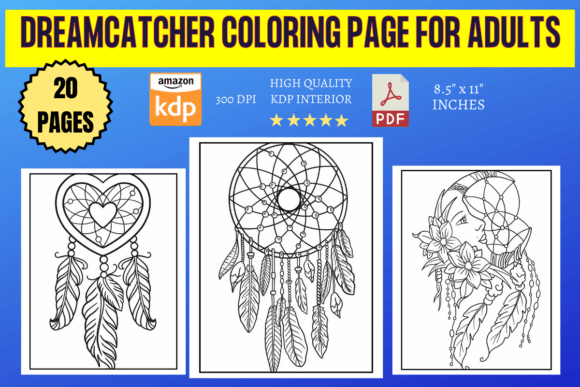
This set of 20 Dreamcatcher Coloring Pages was built with how adults actually use printable resources — not how stock imagery suggests they *should*. Each page is sized at 8.5″ x 11″, matching standard US letter paper and most home printers. No scaling, no cropping, no guesswork. The files come in two formats: high-resolution 300 DPI JPGs for crisp printing, and transparent-background PNGs ideal for digital artists who layer color in Procreate or Photoshop. That dual-format approach reflects how creators move fluidly between analog and digital — sketching by hand, then refining digitally, or vice versa.
For entrepreneurs and small business owners, the Amazon KDP upload-ready structure matters. No reformatting needed. No bleed adjustments. Just drag, drop, and publish — whether you’re expanding your Etsy shop with themed bundles, building a subscription newsletter with weekly printables, or creating a classroom resource pack for social-emotional learning. Educators tell us these pages work especially well in middle-school art rotations or high-school mindfulness electives — the symbolism sparks discussion, while the detail level accommodates varied motor skill development.
Design Integrity Meets Practical Flexibility
Not all dreamcatcher coloring pages are equal. Some oversimplify the web into rigid geometric grids; others overcomplicate with fussy linework that frustrates rather than soothes. This collection avoids both pitfalls. Each of the 20 designs balances organic flow with structural clarity: webs vary from tight concentric circles to asymmetrical, free-form weaves; feathers range from long, flowing plumes to clustered downy shapes; some include subtle background elements — crescent moons, soft stars, or minimalist trees — that suggest context without crowding the focal point.
That variation serves real needs. A marketing manager might prefer a bold, high-contrast layout for quick stress relief during lunch. A graphic designer may choose a version with fine linework and delicate bead clusters to warm up hand-eye coordination before a client presentation. A parent helping a child with sensory regulation might select one with generous spacing and clear outlines — easy to color with thick crayons or adaptive grips. The diversity isn’t arbitrary; it mirrors how adults self-select tools based on energy level, time available, and desired outcome.
From Personal Practice to Shared Value
What starts as a solo coloring session often becomes something more. Teachers print copies for students to personalize before a unit on Native American literature (paired with respectful, sourced background reading). Therapists use completed pages as conversation prompts: “What part felt hardest to fill in? What did you leave open — and why?” Bloggers feature finished pieces in “slow living” roundups, linking back to the original download — turning passive consumption into active curation. Even remote teams have begun sharing scanned pages in Slack channels as low-pressure icebreakers — no talking required, just shared presence in creation.
This shift reflects a broader movement away from productivity-as-identity. Adults aren’t seeking coloring pages to “optimize” relaxation — they’re seeking permission to engage their hands without agenda. The dreamcatcher, as symbol and shape, supports that. Its circular form gently contains attention. Its radial symmetry offers intuitive starting points. Its cultural roots remind us that care practices aren’t new — they’re inherited, adapted, and kept alive through repetition.
Choosing the Right Pages — For You, Your Students, Your Clients
If you’re evaluating coloring resources, look beyond the number of pages. Ask: Does the line art support sustained engagement, or induce fatigue? Are file formats aligned with how you’ll actually use them — printed, digitized, or repurposed? Is the symbolism handled with nuance, not reduction?
This collection answers yes across the board. The 20 designs avoid cliché while remaining accessible. They’re neither childish nor overly esoteric. The high-resolution files ensure fidelity whether printed on matte cardstock for framing or used as overlays in video tutorials. And because each is delivered as an individual PNG or JPG — not locked in a PDF — users retain full control: resize for social posts, isolate elements for stencils, or combine pages into custom workbooks.
Freelancers building digital product libraries appreciate that flexibility. Educators value the clean, classroom-safe aesthetic — no text, no branding, no distractions. Parents love that the same set works for a 7-year-old practicing pencil control and a 42-year-old decompressing after back-to-back Zoom calls. That cross-generational utility isn’t common — but it’s increasingly expected. People don’t want niche tools. They want adaptable ones.
What Comes Next — Not More Pages, But Better Integration
The future of adult coloring isn’t about ever-larger bundles. It’s about intentionality: knowing which design supports which moment. A dreamcatcher with dense webbing may anchor someone during anxiety. One with open space and a single feather might suit a morning ritual of setting intention. The value isn’t in hoarding pages — it’s in recognizing which ones serve your current need, and returning to them without judgment.
That mindset aligns with broader professional trends: iterative learning over linear mastery, contextual tool use over rigid systems, sustainability over accumulation. These 20 Dreamcatcher Coloring Pages reflect that ethos — not as disposable content, but as reusable, respectful, responsive resources. They don’t ask you to change your habits. They meet you where you are: mid-sentence in an email, waiting for a call to connect, sitting beside a child who asks, “Can I color this too?” — and offering a shared language of calm, creativity, and quiet attention.