Garden Coloring Page for Adults
Coloring isn’t just for kids anymore—it’s a grounded, accessible creative practice that supports focus, reduces mental clutter, and invites quiet intentionality. A Garden Coloring Page for Adults bridges aesthetics and mindfulness: intricate botanical linework, layered foliage, winding vines, and natural textures offer just enough complexity to engage the mind without overwhelming it. Unlike abstract or geometric designs, garden-themed pages tap into universal familiarity—roses, lavender, sunflowers, stone paths, trellises—making them instantly resonant and emotionally soothing.
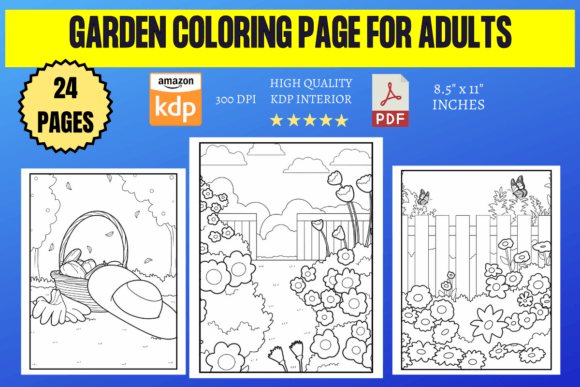
This particular collection stands out not because it’s “more detailed” than others, but because it’s built for real-world use. It includes 24 unique Garden Coloring Pages, each sized at 8.5″ x 11″, delivered as high-resolution 300 DPI JPG files—print-ready, KDP-upload compatible, and optimized for crisp line clarity whether printed on home inkjet printers or professional presses. There are no watermarks, no overlays, no locked layers—just clean, scalable black-and-white line art designed to hold up across formats and audiences.
Creative Possibilities Beyond the Page
These aren’t static images waiting for color—they’re flexible starting points. Designers can isolate individual elements (a single fern frond, a cluster of daisies) and repurpose them as vector-ready motifs for textile patterns, greeting card borders, or social media story frames. Educators use garden pages to support nature literacy: students label plant parts, map pollinator pathways, or annotate seasonal growth cycles directly onto printed copies. Freelance illustrators scan and trace key compositions to build personal style libraries—learning how negative space shapes rhythm, how line weight implies depth, how repetition creates visual harmony.
For content creators and bloggers, these pages serve dual roles: as evergreen lead magnets (e.g., “Download 3 Free Garden Coloring Pages + Care Tips for Indoor Herbs”) and as visual anchors in long-form posts about sustainable gardening, mindful routines, or intergenerational learning. One small business owner used three pages from this set to design a limited-run “Botanical Calm” sticker sheet—paired with QR-linked audio meditations—and sold over 400 units in six weeks through local indie bookshops and Etsy.
Adapting for Different Audiences and Goals
A single Garden Coloring Page for Adults can shift meaning depending on context. For therapists and wellness coaches, it becomes a low-barrier tool for grounding exercises—asking clients to choose one flower and shade only its center before moving outward, mirroring breath awareness. For publishers preparing an Amazon KDP release, the 24-page count aligns cleanly with standard interior requirements; the consistent 300 DPI resolution avoids upload rejections; and the PNG/JPG flexibility allows quick conversion to PDF workbooks or layered Procreate files for digital coloring apps.
Parents and teachers appreciate that these pages work equally well for older kids and adults—no “babyish” simplification, no intimidating abstraction. A 9-year-old might fill a page with glitter glue and bright markers; a 42-year-old graphic designer might use the same layout as a base for experimenting with halftone overlays in Photoshop. That versatility isn’t accidental—it reflects intentional design choices: balanced density (not too sparse, not overcrowded), clear silhouette definition, and varied focal points (some pages emphasize vertical growth, others sprawl horizontally like groundcover).
Practical Tips for Best Results
- Print smart: Use matte or uncoated 100–120 lb cardstock for marker resistance and rich pencil layering. Avoid glossy paper if using alcohol-based markers—it bleeds and feathers.
- Digitally extend: Import any JPG into Canva or Affinity Designer, then adjust contrast to sharpen lines further—or add subtle texture overlays (linen, paper grain) before exporting as a branded PDF workbook.
- Stay organized: Name files descriptively (e.g., Garden-07-Trellis-Roses.jpg) rather than Page_17.jpg. This saves time when curating themed bundles or building course modules.
- Keep it original: If adapting for resale (e.g., as part of a larger activity kit), add value through your own curation—pair a page with planting tips, companion crop notes, or seasonal journal prompts. Don’t rely solely on the line art.
Why Consistency Matters—Without Sacrificing Character
Twenty-four pages could easily feel repetitive—but this set avoids monotony by varying composition logic, not just subject matter. Some pages follow a central radial structure (like a sunflower head); others unfold along a diagonal axis (a climbing jasmine vine); several use asymmetrical balance (a lopsided herb garden with a crooked bench). That structural diversity keeps engagement high across extended use—whether someone colors one page weekly over six months or works through ten in a weekend retreat.
Consistency shows up where it counts: uniform line weight (0.4–0.6 pt), even spacing between stems and petals, and predictable interior detail density. That reliability lets users anticipate how a given page will respond to their tools—no surprise gaps, no vanishing thin lines, no ambiguous outlines. It’s the difference between frustration and flow.
Ideas for Immediate Application
- Build a micro-course: Pair five garden pages with short audio reflections on patience, observation, or seasonal change. Offer it as a $7 self-paced download for educators or mindfulness practitioners.
- Create a physical product: Print all 24 on premium paper, bind with a linen spine, and sell locally as a “Garden Pause Kit”—include a charcoal pencil, blending stump, and seed packet insert.
- Support community outreach: Donate printed sets to senior centers or hospital activity programs. Add a note: “Color one bloom. Name it after someone who helped you grow.”
- Test audience resonance: Post three sample pages on Instagram with different captions—one focused on stress relief, one on botanical education, one on creative warm-ups—and track which drives most saves/shares.
What makes a Garden Coloring Page for Adults truly useful isn’t novelty—it’s reliability, adaptability, and respect for the user’s time and intent. These 24 pages don’t ask you to become an artist. They invite you to notice, to slow, to connect—to plants, to process, to possibility—using tools you already have. Whether you’re designing a client deliverable, prepping a classroom lesson, launching a small product line, or simply reclaiming ten minutes of calm before dinner, the garden is already drawn. All you need to do is begin.