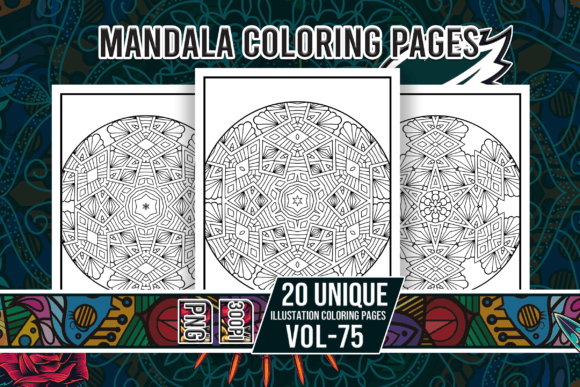
Mandala Coloring Pages Vol-75 Interiors
If you’ve ever sat down with a coloring book after a long day—only to find the designs too simple, too repetitive, or missing that quiet, grounded energy interiors bring—you’ll recognize why Mandala Coloring Pages Vol-75 Interiors stands out. This isn’t just another set of circular patterns. It’s a thoughtfully curated collection built around architectural intimacy: doorways, arched windows, tiled courtyards, layered balconies, and interior nooks rendered in intricate mandala symmetry. Each page invites focus—not just through repetition, but through spatial storytelling.
Where real people actually use these pages—beyond “just coloring”
A freelance graphic designer in Portland prints three pages weekly and tapes them beside her dual monitors—not as decoration, but as visual anchors during client revisions. She traces the curves with her finger while reviewing layout spacing, using the rhythm of interior arches to recalibrate her eye for proportion. A homeschooling parent in Ohio uses two pages per month as part of a “mindful art hour”: her 11-year-old sketches over the outlines with fine liners, then shades them with watercolor pencils. The mandala structure gives him confidence—he knows where lines connect, how symmetry balances, and when a composition feels resolved.
Meanwhile, a small press publisher in Nashville uploaded the full 20-page PNG set directly into KDP last spring. Within six weeks, their paperback version ranked on page one for “interior mandala coloring book” on Amazon. Why? Because buyers searching for “printable mandala interiors,” “KDP-ready coloring pages,” or “architectural mindfulness coloring” found exactly what they needed—no extra editing, no resizing, no guesswork about bleed or margins.
Why interiors make this volume different—and more usable
Mandala Coloring Pages Vol-75 Interiors shifts attention inward—not just emotionally, but physically. Instead of cosmic swirls or botanical borders, you get floor plans reimagined as sacred geometry: a central courtyard framed by repeating colonnades, a stairwell spiraling like a nautilus, a fireplace mantel echoing concentric bands. These aren’t decorative abstractions. They’re spaces people recognize—places they’ve stood in, lived in, longed for. That familiarity lowers the barrier to engagement. You don’t need to “get” mandalas to feel drawn into a tiled entryway or a vaulted ceiling rendered in precise, printable detail.
That’s especially valuable if you’re building a KDP catalog. Buyers scrolling through thousands of coloring books respond faster to recognizable context. “Interior mandala” signals both theme and function—it tells them this is for relaxation *and* spatial imagination. It also opens cross-category appeal: interior designers browsing for client handouts, architecture students needing stress-relief between studio critiques, even real estate agents looking for branded mindfulness tools for open house kits.
What changes when you work with print-ready PNGs instead of PDFs or JPEGs
The 20 A4-sized PNG files aren’t just high-res—they’re optimized for real-world printing workflows. No transparency issues. No compression artifacts near fine linework. No color profile mismatches that mute contrast on home printers. When a teacher in Austin downloads the bundle and prints 30 copies for her middle school art class, every arch, tile edge, and window mullion stays crisp—even on budget inkjet paper. When a blogger embeds a single page as a lead magnet (“Download your free interior mandala page”), it loads fast, scales cleanly on mobile, and retains enough detail for digital coloring apps like Procreate or Adobe Fresco.
And because each file is individually named (e.g., mandala_interior_courtyard_01.png), batch-uploading to KDP becomes frictionless. No renaming. No folder chaos. Just drag, drop, assign, and publish—especially helpful if you’re managing multiple low-content titles across niches like mindfulness, architecture, or adult education.
Who benefits—and how it shows up in daily work
- KDP entrepreneurs: You get 100 unique illustrations across the full Vol-75 series—but this interior-focused subset lets you test a micro-niche before scaling. Run a $2.99 eBook with just these 20 pages. See if “interior mandala” converts better than generic mandalas in your ads. Then expand.
- Educators and therapists: The architectural framing supports grounding exercises. Ask students to color the “entryway” first—symbolizing intention—then move inward toward the center. That physical progression mirrors therapeutic pacing.
- Content creators: Use one page per Instagram carousel post. Caption it with prompts like “What memory does this doorway hold?” or “Where would you hang this in your ideal home?” Engagement spikes when design meets personal reflection.
- Hobbyists and retirees: No screen fatigue. No app logins. Just paper, pencil, and the quiet satisfaction of filling a tiled alcove—line by deliberate line.
Before you download—what to keep in mind
This collection assumes you want ready-to-use assets—not templates to modify. If you plan to recolor, layer, or vectorize the files, PNGs work fine, but you’ll need basic image editing skills. If you’re new to KDP, double-check Amazon’s latest interior file requirements (they occasionally update DPI or margin specs)—though all 20 files currently meet KDP’s 300 DPI, 8.5 x 11 inch, bleed-free standard.
Also, while every page is unique, they share a consistent line weight and spacing logic. That’s intentional—it creates cohesion across the volume. But if you prefer wildly varied styles (e.g., sketchy vs. ultra-clean), this set leans toward refined precision over expressive looseness.
Finally, consider how you’ll extend value beyond the download. One Etsy seller pairs each printed page with a short audio guide (“Breathe with this archway”) sold separately. Another bundles five interior mandalas with printable journal prompts about belonging, thresholds, and sanctuary. The files are the foundation—not the full experience.
Mandala Coloring Pages Vol-75 Interiors works because it meets people where they are: at kitchen tables, in studio apartments, behind laptops, in classrooms, and inside their own breath. It doesn’t ask you to become more mindful—it gives you a doorway, already drawn, already waiting.