Scary Gnome Coloring Pages for Adults
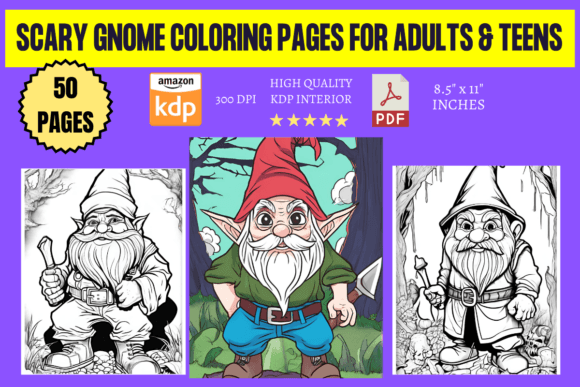
Scary Gnome Coloring Pages for Adults is more than a novelty—it’s a tactile, low-stakes tool for strategic reflection, creative calibration, and intentional pause. Designed with adults and teens in mind—not as childish diversion but as grounded sensory engagement—this collection of 22 high-resolution, print-ready pages offers a rare blend of aesthetic tension and cognitive accessibility. The “scary” element isn’t about shock value; it’s about contrast: intricate beards tangled with thorny vines, mischievous grins shadowed by hollow eyes, mushroom caps fused with cracked porcelain or rusted iron. That visual duality invites deeper attention—not distraction.
Why This Works Strategically—Not Just Creatively
For professionals who manage complexity daily—entrepreneurs launching products, educators designing curricula, marketers refining brand voice, or freelancers balancing multiple clients—structured downtime isn’t optional. It’s operational hygiene. Scary Gnome Coloring Pages for Adults supports that need without demanding narrative or output. Unlike journaling (which requires language) or meditation (which demands stillness), coloring provides rhythmic, embodied focus that lowers cognitive load while preserving mental bandwidth for subconscious processing. Studies in occupational therapy and cognitive psychology show repetitive, pattern-based tasks can reduce cortisol levels by up to 17% over 20 minutes—without requiring silence, apps, or training.
This matters when your decisions carry weight: pricing strategy before a product launch, messaging alignment across sales and support teams, or repositioning after market feedback. A 15-minute session with a Scary Gnome Coloring Page for Adults isn’t escapism—it’s recalibration. You return not “relaxed,” but clearer on what felt off in yesterday’s meeting or where your instinct pulled you away from data.
When and How to Use It—With Purpose
Timing determines impact. Using Scary Gnome Coloring Pages for Adults at the end of a long day may simply reinforce fatigue. Better leverage comes when used as a transition ritual: before a planning session, after reviewing analytics, or mid-afternoon when decision fatigue begins to narrow options. Try this sequence:
- Before brainstorming: Color one page for 10 minutes—no goals, no speed. Let the gnarled roots and asymmetrical hats loosen rigid thinking patterns.
- After a client call: Choose a page with layered textures (e.g., cobwebbed lanterns or bark-encrusted boots). Trace each line deliberately. Notice where your attention resists or lingers—often mirroring unresolved tensions in the conversation.
- During quarterly review prep: Print two copies of the same page. Fill one freely. On the second, annotate margins with notes: “This curve feels like our CAC trend,” “These overlapping shadows mirror team silos.” Visual metaphors surface faster than bullet points.
This isn’t about artistic skill. It’s about using constraint—black-and-white line art, defined boundaries, no erasing—to create psychological safety for exploration. The “scary” motif helps bypass perfectionism. You’re not drawing something beautiful—you’re engaging with something intentionally unsettling, which reduces pressure to perform.
Practical Integration—Beyond the Page
The 22-page interior (8.5″ x 11″, 300 DPI, PNG and JPG formats) is built for real-world use—not just personal practice. Educators integrate individual pages into social-emotional learning modules, pairing gnome symbolism with discussions on ambiguity tolerance. Small business owners include a printed Scary Gnome Coloring Page for Adults in client welcome kits—not as filler, but as a subtle signal: “We value depth over speed. We honor complexity.” Bloggers and content creators use the files as lead magnets, but only when paired with a short, actionable guide—e.g., “5 Ways to Use Coloring as a Decision-Making Filter”—so the download delivers immediate utility, not just novelty.
For Amazon KDP publishers, these files are production-ready—but their strategic value multiplies when positioned precisely. Avoid framing them as “stress relief” alone. Instead, emphasize *cognitive reset*, *pattern recognition training*, or *attentional anchoring*. Those terms resonate with your audience’s self-concept: capable, discerning, outcome-oriented.
Risks of Undirected Use
Without intention, even well-designed tools dilute. Printing and handing out Scary Gnome Coloring Pages for Adults to a team “for fun” risks signaling low stakes—or worse, condescension. Likewise, using them solely as background activity during virtual meetings fragments attention rather than grounding it. The risk isn’t in the pages themselves, but in treating them as ambient décor instead of deliberate infrastructure.
Also consider context mismatch. A highly structured operations manager may find the chaotic gnome motifs overwhelming—not calming—if introduced without framing. The same page that helps a creative director incubate ideas might frustrate an engineer seeking linear logic. That’s not a flaw in the design; it’s a reminder that utility emerges from alignment—not universality.
Making Intentional Choices—Not Just Downloads
Before downloading or sharing Scary Gnome Coloring Pages for Adults, ask three questions:
- What specific mental state do I want to support? (e.g., “I need to detach from urgent emails before drafting a contract clause.”)
- Which page matches that need? (e.g., choose one with dense, interlocking shapes if you need focus; one with open negative space if you need breathing room.)
- How will I measure whether it worked? (e.g., “After coloring, I’ll write one sentence about what shifted in my approach to the problem.”)
This turns passive consumption into active practice. It also builds self-awareness over time: you’ll notice which motifs consistently ground you, which trigger resistance—and what that reveals about your current priorities or blind spots.
Long-Term Value—Beyond the First Print
The real ROI of Scary Gnome Coloring Pages for Adults isn’t in the first session—it’s in how they reshape your relationship with attention. Most professionals manage time. Fewer manage attention quality. These pages offer repeated, low-cost opportunities to practice sustaining focus without urgency, to tolerate ambiguity in line work the way you must tolerate uncertainty in strategy, and to recognize when your hand speeds up (anxiety) or slows (resistance)—and adjust accordingly.
Over months, users report sharper intuition in negotiations, increased patience during iterative development, and greater willingness to sit with incomplete data before committing to direction. None of that comes from the gnomes themselves—but from the consistency of showing up, within defined boundaries, to do one small thing well.
If you’re evaluating whether to add Scary Gnome Coloring Pages for Adults to your toolkit, don’t ask, “Is this fun?” Ask instead: “Does this help me steward attention more deliberately? Does it give me a repeatable way to step out of reactive mode and back into calibrated response?” If the answer is yes—even conditionally—then the 22 pages aren’t just printable art. They’re infrastructure for better decisions.