Gingerbread House Coloring Pages for Kid
Coloring isn’t just downtime—it’s a functional tool in early childhood development, classroom planning, event coordination, and even small business operations. Gingerbread House Coloring Pages for Kid is a purpose-built digital asset: 160 high-resolution, print-ready coloring pages designed for flexibility, consistency, and immediate deployment. Unlike generic clipart or scattered free downloads, this collection is structured, standardized, and production-ready—making it a practical resource for educators designing holiday lesson plans, entrepreneurs launching seasonal printables shops, or parents preparing low-prep, screen-free activities during busy December weeks.
How It Fits Into Real Workflows
This isn’t a novelty download—it’s a workflow component. When you’re managing multiple responsibilities—teaching a mixed-age class, fulfilling Etsy orders, or coordinating a school holiday fair—the time saved by using a cohesive, pre-vetted set of coloring pages compounds quickly. Each of the 160 Gingerbread House Coloring Pages for Kid is sized to 8.5″ x 11″, optimized at 300 DPI, and delivered as both PNG and JPG files. That means no resizing, no pixelation, no last-minute troubleshooting before printing or uploading to Amazon KDP. You move from decision to delivery in under two minutes—not two hours.
For educators, these pages integrate directly into existing curriculum scaffolds: use them as fine-motor warm-ups before handwriting practice, as quiet focus tools during literacy rotations, or as customizable stationery for holiday cards students design themselves. For creators, the files are KDP-upload ready—no additional formatting, bleed setup, or margin adjustments needed. For parents and caregivers, the consistent size and resolution mean one printer setting works across all 160 pages—no toggling between “fit,” “actual size,” or “borderless” mid-batch.
Preparation and Compatibility: What You Need to Know Before Use
Before downloading or assigning pages, consider your output path. If you plan to print at home, confirm your printer handles standard letter-size paper reliably—and that your ink or toner levels support 160 pages (or batch-print selectively). If you’re uploading to Amazon KDP, verify your interior file meets current guidelines: 300 DPI, CMYK color mode (though RGB is acceptable for grayscale line art), and no embedded fonts or layers. These Gingerbread House Coloring Pages for Kid are delivered as flat, single-layer raster images—so they pass KDP validation without conversion.
Compatibility extends beyond software. The PNG files retain transparent backgrounds, useful if you’re layering designs into Canva templates, editing in Photoshop, or importing into Cricut Design Space for cut-and-color hybrid projects. The JPG versions load faster in email attachments or LMS platforms like Google Classroom—ideal when sharing with remote learners or parent volunteers who need quick access without specialized software.
Organization and Efficiency Across Use Cases
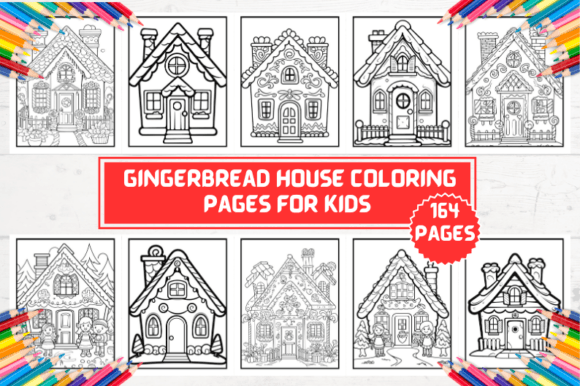
With 160 pages, organization isn’t optional—it’s operational. The collection includes varied complexity: simple outlines for ages 3–5, medium-detail houses with candy cane columns and gumdrop roofs for ages 6–8, and intricate architectural interiors with staircases, fireplaces, and window panes for older kids or adult colorists. This gradient allows for tiered assignments, differentiation without extra prep, and reuse across grade levels or family groups.
Practically, group pages by use case—not just difficulty. For example:
- Classroom Stations: Assign 5–7 themed pages per station (e.g., “Candy Details,” “Holiday Lights,” “Roof Patterns”) so students rotate through focused skill-building—symmetry, pattern recognition, color theory—without repeating identical tasks.
- Event Kits: Bundle 10–12 pages into printable PDFs for holiday parties, library story times, or church Advent programs. Include a cover page and blank backside for easy stapling into mini-books.
- Digital Integration: Upload individual PNGs into interactive whiteboard software (like SMART Notebook or Miro) for guided group coloring sessions—then save annotated versions as visual records of student engagement or vocabulary use (“What kind of candy is on the roof? How many windows do you see?”).
Quality Control and Long-Term Usability
Line consistency matters. Thin, jagged, or uneven strokes fatigue young hands and create frustration—not flow. Every Gingerbread House Coloring Pages for Kid uses clean, uniform 2–3 pt line weights, with intentional spacing between elements (e.g., clear separation between wall sections and rooflines) to prevent accidental color bleed-through. That consistency reduces rework: fewer smudges, fewer redrawn outlines, fewer requests for “another copy.”
Long-term usability hinges on format stability. Raster files don’t rely on font embedding or vector scaling—so what prints today prints identically six months from now, whether opened in Preview, Adobe Acrobat, or Microsoft Photos. No version conflicts. No missing assets. No dependency on subscription software. That reliability supports sustainability: print only what you need, when you need it, without worrying about expiring licenses or platform updates breaking functionality.
Integration With Other Tools and Assets
These pages don’t exist in isolation—they’re designed to interface cleanly with common tools. In Canva, drag and drop any PNG to resize proportionally while preserving crisp edges. In Excel or Airtable, store filenames with metadata tags (e.g., “GH-042_simple_roof,” “GH-118_detailed_interior”) to build searchable inventories for lesson planning or inventory tracking. Pair them with physical supplies: list recommended crayon brands (e.g., Crayola Supertips for control, Faber-Castell Pitt Artist Pens for fine detail) in your activity guide—or link to affiliate-friendly supply bundles if selling curated kits.
For content creators, the pages serve dual roles: as finished products (sold individually or in themed bundles) and as raw assets for derivative work. Add subtle watermarks or custom headers to branded PDFs. Layer scanned student-colored versions into social media carousels showing real outcomes—not just product shots. Repurpose house outlines as templates for writing prompts (“Describe what happens inside this gingerbread house at midnight”) or math challenges (“Count how many gumdrops are on the left side of the roof”).
Implementation Tips That Save Time
Start small. Don’t print all 160 at once. Test three pages across different age groups or settings—note which hold attention longest, which generate the most descriptive language, which require the least redirection. Use those insights to prioritize batches for future printing or digital distribution.
Batch-edit smartly. If you need to add your logo or copyright notice, use bulk-processing tools like Adobe Bridge or XnConvert—apply watermarks or resize uniformly across folders instead of editing each file manually. For KDP, rename files sequentially (GH-001.png, GH-002.png…) before uploading; KDP imports interiors in filename order, so logical naming ensures your book flows cohesively.
Track usage. Keep a simple log: date, context (e.g., “Grade 2 art rotation”), number of pages used, observed engagement level (low/medium/high), and one concrete outcome (“Student A named 7 candy types unprompted”). Over time, this builds evidence of efficacy—valuable for grant applications, curriculum reviews, or refining your own product offerings.
Finally, treat the collection as infrastructure—not decoration. Like having reliable Wi-Fi or a well-organized supply closet, having 160 Gingerbread House Coloring Pages for Kid on hand changes how you allocate mental bandwidth. You spend less time searching, troubleshooting, or improvising—and more time facilitating, observing, and responding. That shift—from reactive to intentional—is where real workflow leverage begins.