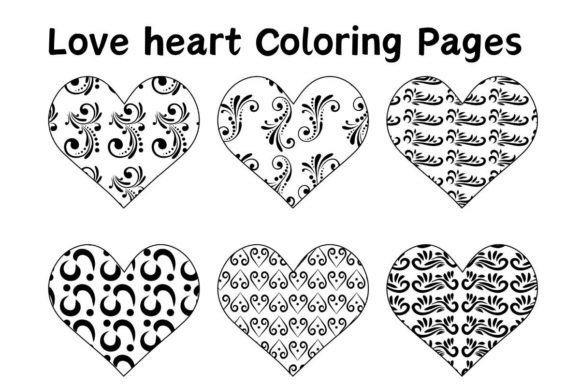
Love Heart Coloring Pages
Love Heart Coloring Pages is a purpose-built digital printable resource designed for creators building high-content children’s activity books—especially those targeting toddlers, preschoolers, and early kindergarten learners. It’s not just a collection of heart-themed line art; it’s a production-ready interior template engineered for Amazon KDP publishing workflows. Each page supports developmental goals—fine motor skill practice, color recognition, emotional vocabulary building—and meets technical requirements for print-on-demand platforms without requiring design rework.
Where Love Heart Coloring Pages Fits in Your Publishing Workflow
This package enters your process at the *interior asset creation* stage—not after cover design, not during keyword research, but precisely when you need verified, bleed-compliant, KDP-tested pages that convert into a physical product with zero formatting surprises. You’re not starting from scratch with vector tools or wrestling with margin calculations. Instead, you’re inserting a known, stable component into an otherwise complex chain: concept validation → cover design → interior integration → preview testing → listing optimization → launch.
For entrepreneurs running multiple KDP titles, this eliminates one recurring bottleneck: generating clean, consistent, age-appropriate interiors that pass KDP’s automated preflight checks. The 10 unique pages are sized to 8.5″ × 11″ with full bleed, meaning no white edges or cut-off lines when printed. That consistency directly impacts perceived quality—and reduces customer returns or negative reviews tied to misaligned artwork.
How It Integrates With Your Existing Tools and Systems
The deliverables—PDF, AI, EPS, and JPEG files—are selected for interoperability, not redundancy. Use the PDF as your final upload file (it’s print-ready and KDP-validated). Open the AI file in Adobe Illustrator to adjust line weight, add custom text, or integrate brand elements like a subtle logo watermark in the corner. The EPS version ensures compatibility with older vector software or third-party prep tools used by some freelancers or print service providers. JPEGs serve as quick-reference previews or for social media teasers—no need to render thumbnails manually.
If you use Canva for cover design, import the JPEGs to mock up realistic book previews. If you outsource editing, send the AI file to your designer—they’ll appreciate editable layers and ungrouped paths. If you batch-create interiors across multiple themes (e.g., “Valentine’s Day,” “Friendship,” “Emotions”), these heart pages become a modular unit you can drop into a master template, keeping visual rhythm and spacing uniform across your catalog.
Practical Implementation Tips for Real-World Use
Start with your audience’s cognitive load. Toddlers and young kindergarteners need bold outlines, minimal internal detail, and generous spacing between elements. These pages deliver exactly that—no tiny petals, no intricate lace patterns, no overlapping shapes that cause coloring frustration. That intentional simplicity isn’t a limitation; it’s a usability decision aligned with early childhood development benchmarks.
Test before you list. Even with KDP-tested files, always generate a physical proof copy. Check how black lines reproduce on standard 60–80 lb paper—some printers mute thin strokes. If needed, open the AI file and increase stroke width to 1.5 pt. That minor edit preserves clarity without altering the artistic intent.
Bundle strategically. While this set stands alone, its real workflow value multiplies when combined. Pair it with a companion cover template (designed for 8.5″ × 11″ + 0.25″ bleed), a matching title page, and a simple “How to Use This Book” instruction sheet. That turns 10 pages into a cohesive, branded mini-book—ideal for low-risk test launches or seasonal promotions.
Quality Control and Long-Term Usability
Each of the 10 pages is unique—not variations of one image, but distinct compositions: hearts with wings, hearts cradling animals, hearts wrapped in ribbons, hearts with smiling faces, hearts containing simple patterns (dots, stripes, zigzags). That variety prevents visual fatigue across the book and gives buyers tangible value—no filler repeats. From a production standpoint, uniqueness also helps avoid Amazon’s duplicate content filters if you later expand into related themes.
The files are structured for long-term reuse. Layer names in the AI file are descriptive (“Heart_03_Outline”, “Heart_07_Shadow_Off”). There are no embedded fonts or linked assets—everything is outlined or rasterized appropriately. That means you can reopen the file six months later, make edits, and export without hunting down missing resources. No version drift. No broken links. Just predictable, repeatable output.
Workflow Examples Across User Roles
Educators and homeschoolers: Print individual pages for fine motor centers or emotion-regulation activities. Laminate one page and use dry-erase markers for repeated use—no need to buy consumable workbooks. The clean lines hold up well under erasing.
KDP publishers: Use the PDF as-is for your first upload. Then, use the AI file to create a “deluxe version” with thicker outlines and simplified shapes for younger audiences—or a “challenge version” with light background textures for older kids. Same base asset, two SKUs, minimal extra effort.
Freelance designers: Offer this as a white-label interior option to clients launching children’s activity books. Include a brief style guide showing how to match cover typography and color palettes to the interior’s line weight and spacing. Clients get speed; you get consistency and fewer revision rounds.
Small business owners selling printables: Convert the JPEGs into instant-download PNGs with transparent backgrounds for crafters using Cricut or Silhouette. Add a single-line border and label each as “SVG-Ready Outline”—no extra design time, just smart repurposing.
What to Do Next—Without Overcomplicating It
You don’t need to redesign the wheel. You need a reliable, tested interior block that fits seamlessly into your existing process. Love Heart Coloring Pages delivers that. It’s not about adding more steps—it’s about removing friction where it already exists: inconsistent sizing, failed KDP uploads, last-minute bleed adjustments, or mismatched line weights across pages.
Your next move depends on your current priority. If you’re preparing a Valentine’s Day launch, add this to your cart, pair it with a coordinating cover, and run your KDP preview. If you’re auditing your interior production pipeline, compare how many hours you spend rebuilding similar assets versus how quickly you could integrate this set. If you’re scaling a series, treat these 10 pages as your baseline module—then build variations around them, not from scratch.
It works because it’s built for execution—not inspiration. It assumes you’ve already done the market research, chosen your niche, and understand your audience’s developmental needs. What it solves is the quiet, time-consuming part: getting clean, compliant, usable pages onto the platform—without guesswork, without rework, and without compromising on quality or age-appropriateness.