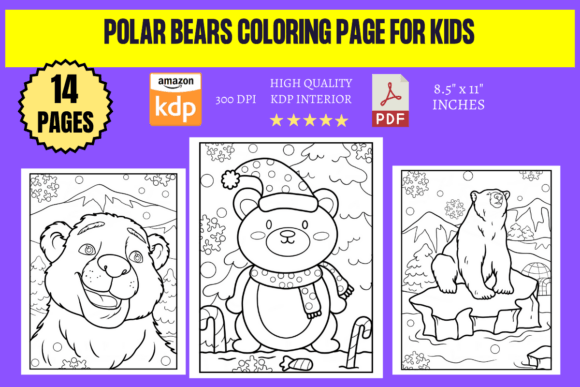
Polar Bears Coloring Page for Kids
A Polar Bears Coloring Page for Kids is more than a simple activity sheet—it’s a versatile, high-leverage digital asset with strategic utility across education, publishing, branding, and small business operations. At its core, it’s a set of 50 thoughtfully designed, print-ready coloring pages—each sized 8.5″ x 11″, delivered as high-resolution 300 DPI JPG and PNG files, optimized for both home printing and professional platforms like Amazon KDP. But its real value emerges not from quantity alone, but from how intentionally it’s deployed.
Why This Isn’t Just Another Coloring Book
Most coloring resources are generic or hastily assembled. This collection stands apart because it’s built with purpose: each of the 50 Polar Bears Coloring Pages is original, scalable, and context-aware. The designs balance simplicity for early learners (ages 3–6) with subtle detail to engage older children (7–10)—a deliberate range that expands usability without requiring multiple product SKUs. That duality matters strategically: it means one file set can serve homeschoolers, classroom teachers, daycare providers, and indie publishers alike—reducing inventory complexity while increasing audience reach.
For creators building digital product bundles, this set integrates cleanly with themed learning kits—e.g., Arctic science units, winter holiday activity packs, or social-emotional learning tools focused on calm and focus. For educators, the consistency in size and resolution eliminates formatting friction when embedding pages into lesson plans or LMS platforms. For Amazon KDP publishers, the files are pre-optimized: no resizing, no bleed adjustments, no color profile guesswork—just upload and go. That saves hours per title and reduces rejection risk during platform review.
Strategic Use Cases Beyond “Just for Fun”
When used deliberately, a Polar Bears Coloring Page for Kids becomes a tactical tool—not just a passive resource. Consider these grounded applications:
- Brand extension for eco-conscious businesses: A wildlife sanctuary, sustainable toy brand, or climate education nonprofit can license or adapt these pages as branded take-home materials—adding their logo, mission statement, or QR code linking to conservation resources. The polar bear motif reinforces messaging about habitat loss and stewardship, turning play into quiet advocacy.
- Low-friction lead generation: Bloggers and educators can offer one page as a free download in exchange for an email address—then nurture subscribers with science facts, printable tracking charts, or seasonal activity calendars. Because the design is clean and universally appealing, conversion rates tend to outperform generic “free PDF” offers.
- Classroom differentiation without prep time: Teachers use different pages based on skill level—simpler outlines for fine-motor development, denser scenes for pattern recognition or storytelling prompts. No need to curate or scan; all 50 are ready, consistent, and pedagogically coherent.
- Small-batch physical product creation: Print shops, craft fairs, or Etsy sellers can bind select pages into mini booklets, pair them with colored pencils as gift sets, or laminate individual sheets for reusable dry-erase activities. The high-res files ensure crisp results even on matte or textured paper stocks.
What to Consider Before Deployment
Intentionality separates effective use from wasted effort. Before integrating a Polar Bears Coloring Page for Kids into your workflow, ask three questions:
- What outcome am I trying to support? If it’s student engagement, prioritize pages with open-ended elements (e.g., blank sky or ice floes for drawing extensions). If it’s brand visibility, choose designs with ample margin space for logos or taglines. If it’s KDP scalability, verify that all 50 files conform to interior template specs—not just size, but naming convention and layer flattening.
- Who owns the usage rights—and what are the boundaries? These files are for personal and commercial use, but that doesn’t mean unrestricted modification. Altering copyrighted elements (e.g., adding licensed characters) or reselling the raw files as standalone digital assets violates terms. Clarity here prevents legal exposure and preserves long-term flexibility.
- How does this align with existing systems? A beautifully designed page loses value if it doesn’t import cleanly into your LMS, Canva workflow, or print-on-demand dashboard. Test one file first—check color fidelity on screen vs. printed output, confirm transparency handling in PNGs, and validate that JPG compression hasn’t introduced artifacts near fine lines.
Risks of Undirected Use
Without clear goals, even high-quality assets become noise. Common pitfalls include:
- Overloading audiences: Dropping all 50 pages into a single email or download link overwhelms users. Decision fatigue sets in. Instead, sequence them—e.g., “Week 1: Habitat Pages,” “Week 2: Bear Behavior Scenes”—to build rhythm and anticipation.
- Misaligned expectations: Marketing this as “educational” without supporting context (e.g., species facts, map references, discussion prompts) dilutes perceived value. Pair pages with brief, actionable notes—even one sentence per page (“Talk about: Why do polar bears have black skin under white fur?”)—to deepen learning and justify premium pricing.
- Operational blind spots: Assuming “print-ready” means “plug-and-play” across all vendors. Some POD services require CMYK profiles or specific margins. Always run a test print before bulk production—or better yet, keep a calibrated reference print on file to spot-check new batches.
Long-Term Value Through Iterative Use
The strongest returns come not from one-time deployment, but from layered reuse. Think of the 50 Polar Bears Coloring Pages as modular components—not static endpoints. Here’s how forward-looking users extend their lifespan:
A curriculum designer might start with 10 pages for a winter unit, then six months later repurpose 15 others as part of a “Arctic Adaptations” STEM challenge—adding measurement grids, temperature scales, or food web overlays in editing software. An indie publisher could release Volume 1 (pages 1–25) as a softcover book, then offer Volume 2 (26–50) as a bonus for newsletter subscribers—creating urgency and rewarding loyalty. A therapist specializing in sensory regulation might print select pages on weighted paper stock and integrate them into calm-down kits, tracking which designs most consistently reduce agitation across sessions.
This kind of evolution requires documentation—not just of what you own, but of how it performs. Keep a simple log: date deployed, channel used, observed engagement (e.g., “Page #12 had 3x longer dwell time in PDF preview”), and follow-up action (“Add habitat labels to next version”). Over time, patterns emerge—revealing which designs resonate most with specific age groups, learning styles, or delivery methods.
Final Strategic Note
A Polar Bears Coloring Page for Kids succeeds not because it’s charming or well-made—though it is—but because it’s designed to be acted upon. Its 50 pages aren’t filler; they’re decision points. Each one invites a choice: Will this support focus? Build knowledge? Strengthen a relationship with a customer? Streamline a process? Anchor a brand story? Answer those questions clearly before printing, uploading, or sharing—and you’ll move beyond decoration into deliberate impact.